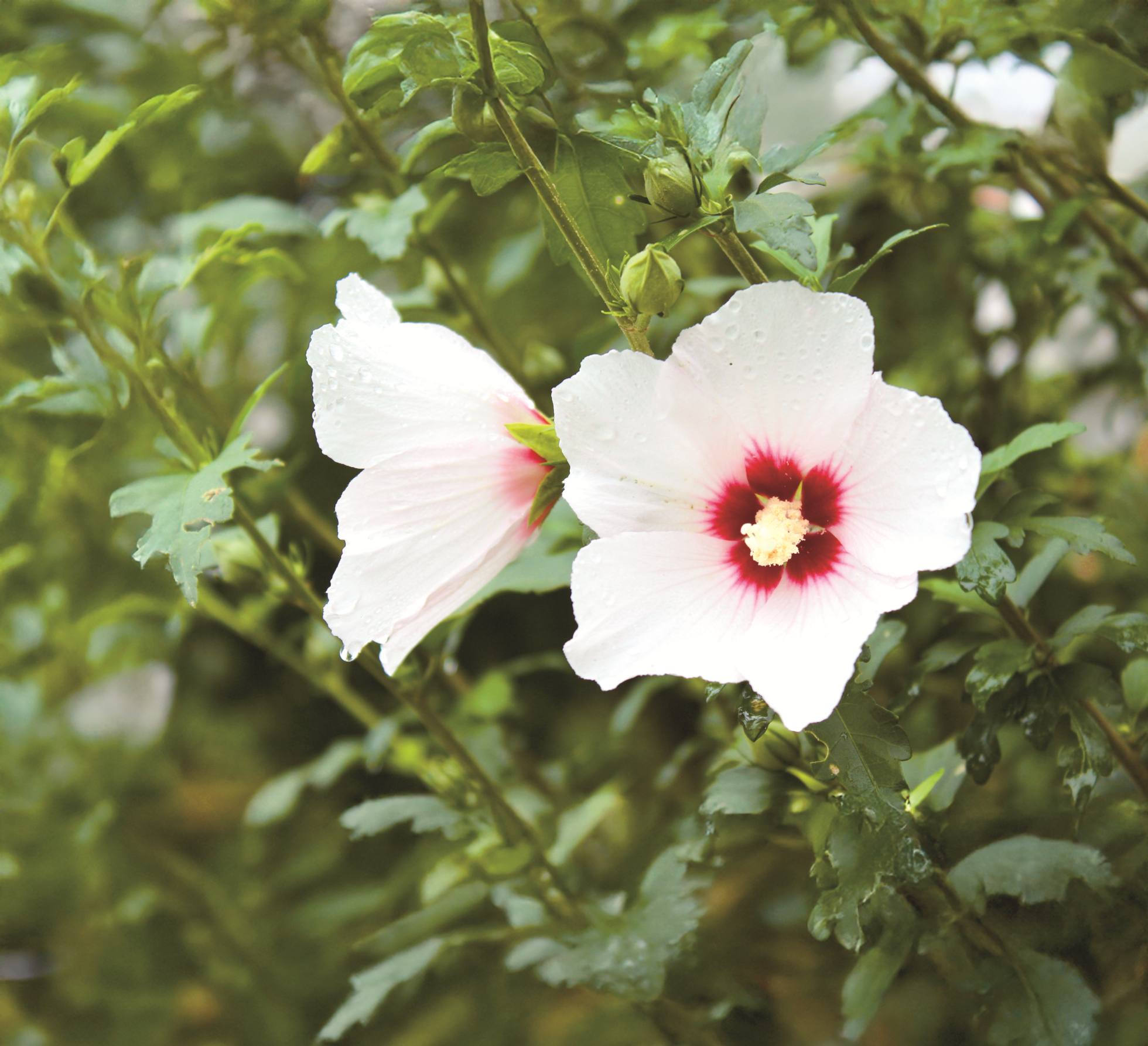
“Three thousand ri1 of splendid rivers and mountains covered with mugunghwa blossoms.”
This line from the chorus of the Korean national anthem refers to the Rose of Sharon. Alongside the national flag, the anthem, the state seal, and the national emblem, it is regarded as one of the five symbols of the Republic of Korea. Although it has never been officially designated as the national flower, its connection to the Korean Peninsula runs deep. Historically, during the Silla and Joseon dynasties, Korea was often called Geunhwahyang or Geunhyang—meaning “the Land of Mugunghwa.” During the Japanese colonial period, the flower frequently appeared in the songs and poems of independence fighters, becoming a powerful symbol of patriotism and resilience.
The mugunghwa blooms from July through October. Unlike many flowering trees, its flowers do not all open and fall at once; instead, they bloom and wither in steady succession. As the stems grow, new buds continuously form and gradually blossom from the lower branches upward—a botanical pattern known as an “indeterminate inflorescence.” Each individual flower lasts only a single day. It begins to open at dawn, reaches full bloom by morning, starts to wilt in the afternoon, and falls by evening. Yet, for nearly one hundred days, the tree itself appears to remain in constant bloom, producing thousands of flowers throughout the season.
Leaving fallen petals behind as it prepares for the next day’s blossoms, the mugunghwa blooms unceasingly. Fittingly, in the language of flowers, the mugunghwa symbolizes “perseverance” and “endurance.”
--------------------------------
1. A traditional Korean unit of distance, equivalent to approximately 0.244 miles. The phrase Three Thousand Ri is a poetic expression commonly used to refer to the entire Korean Peninsula.
11